
Research

The evidence we're working from

Two programs, two bodies of literature. This is our running summary of what researchers and public agencies report — with citations, and with the gaps left in.

Program 01

Microplastics

Microplastics are plastic particles smaller than 5 mm; nanoplastics are smaller still. They form as larger plastics fragment, and they now turn up routinely in water, air, soil and food supply sampling worldwide.

The measurement science has moved much faster than the health science. Detection methods have improved enormously in the last five years, which is why headline particle counts keep climbing — a shift in what instruments can see, not necessarily in what is there. Researchers are candid that the human health implications remain an open question.

That is exactly the situation where people deserve the sources rather than a conclusion.

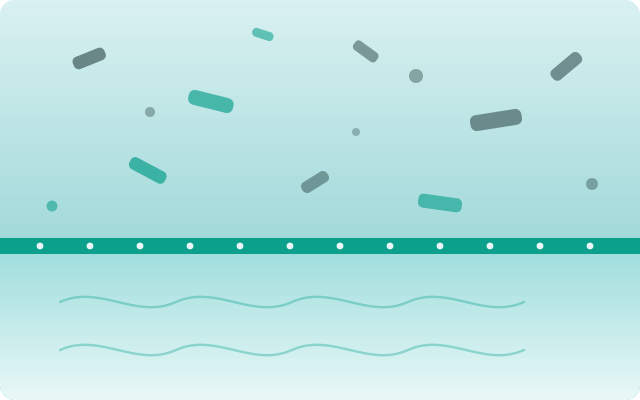
Plastic fragments suspended in water above a filtration membrane

Microplastics: reported figures

460 Mt

Plastics produced worldwide in 2019 — roughly double the 2000 figure

OECD, Global Plastics Outlook (2022)
9%

Share of plastic waste ever recycled globally; about 22% is mismanaged

OECD, Global Plastics Outlook (2022)
~240,000

Plastic fragments per litre in bottled water using newer imaging methods, around 90% of them nanoplastics

Qian et al., PNAS (2024)
17 / 22

Healthy adult blood donors in whom plastic particles were quantified — the first study of its kind

Leslie et al., Environment International (2022)

Where it is being found

Since 2018, published detections have expanded from marine sediment and seafood to drinking water, table salt, human stool, placental tissue and lung tissue. Sampling methods differ significantly between studies, so counts are not directly comparable.
What WHO has said

The World Health Organization's 2019 review of microplastics in drinking water concluded the available evidence was limited, and called for better-quality studies rather than issuing a health-based guideline value. That call has largely driven the work since.

The honest caveat

Detection is not the same as harm. Most human exposure studies to date are small, cross-sectional, and lack a control for laboratory plastic contamination. Anyone selling you certainty here is ahead of the evidence.

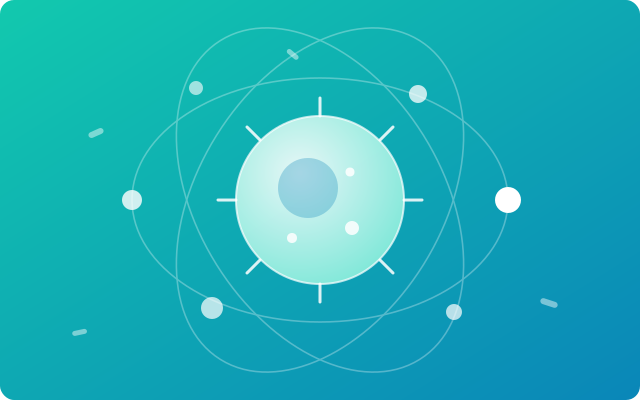
A cell surrounded by orbiting immune signalling markers
Program 02

Immune resilience

The immune system is the body's response network, and it is unusually sensitive to inputs — sleep, nutrition status, stress, infection history and environmental exposure all appear in the literature as influences on immune function.

Autoimmune conditions, where that network misidentifies the body's own tissue, draw the most research attention. The US National Institute of Environmental Health Sciences treats environmental exposure as one of several factors under active investigation, alongside genetics, sex and infection. Causation is not established for most exposures.

Our second program is deliberately unambitious in what it claims: foundational nutrients at transparent doses, and clear resources about what remains unknown.

Immune and autoimmune: reported figures

80+

Distinct conditions currently recognised as autoimmune diseases

US National Institutes of Health
23.5M+

Americans estimated to be affected; patient organisations put the figure closer to 50 million

NIH; AARDA
11% → 16%

Rise in antinuclear antibody prevalence in the US between 1988–1991 and 2011–2012, sharpest in adolescents

Dinse et al., Arthritis & Rheumatology (2020)
~4 in 5

Share of autoimmune disease patients who are women — one of the field's most consistent and least explained findings

NIEHS

These are population-level research findings. They describe trends observed across large groups, not the effect of any supplement, and they should not be used to interpret your own health. A rising measured prevalence can reflect better detection and broader testing as well as a genuine increase.

We'll publish what we find

As our programs move from reading to formulation to testing, the results go up here — including the ones that don't go our way.

Please note. PTX Labs does not currently sell any product. Nothing on this page is medical advice. The figures cited come from the sources named and describe published research findings, not product outcomes. Consult a qualified healthcare professional about your own health.